
Two models of change – and one lesson
Models help you understand realty and apply knowledge and experience accumulated by others before you. One of the models of organizational change is John P. Kotter’s eight step model of change which guide you through the change process from inspiring people to accept or even want the change to making efforts to ensure lasting results. Its eight steps are detailed and specific suggesting the you will not leave out anything important if you follow the model. Steps like empowering action and creating short term wins also provide you with ideas to make your job as a change manager or change agent easier and seem to give you and advantage over other not following the steps of this model. Specific details, however, may be misleading causing you to feel that they are complete. Especially when you compare them to other, seemingly simpler, therefore less sophisticated models that may not even have a name. The figure below compares Kotter’s model to the five-phase model of change. On the surface, Kotter’s model has a clear advantage. It has more steps so that it provides more guidance. However, details and specificity may also limit your vision and action.
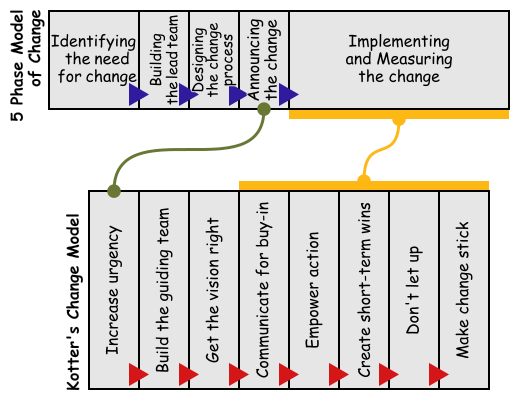
Yes, Kotter’s model provides you with more detailed guidance especially for the implementation phase even though the specific steps may not be the best in every situation. On the other hand, measuring your progress in the implementation phase is not highlighted even though it may be the most important aspect to achieve lasting change. A more important difference is the first step of the two models. Kotter’s model assumes the need for change as given. When this is true and you already have an idea about what kind of change would solve your problem, you may start with increasing urgency but even in this case a pressure of urgency may lead to mediocre planning and poor choices. The five-phase model does not assume we already have a decision about change at the beginning of the process. It starts with identifying the need for change and after compiling the lead team, it continues with planning before announcing the change. Of course, I do not want to devalue the Kotter model. I only want to call your attention to the fact that there are more than one models of change out there and all has their blind spots. Be aware of this and choose the model suiting your situation best. There is no absolute best or totally complete model. Additionally, while more specific and detailed models may give you more guidance and a feel of security during the process, they also limit your vision and your room to maneuver. The more specific model you choose, the more willing you should be to customize or abandon the model if it limits you too much. In summary, get to know as much modes as you can and learn from each of them but do not let yourself be limited by any of them when they do not suit your needs completely.
Get your free book now!
Start meditation now. The simple method I describe in my book works for everyone.
(c) Copiright 2020-2023 | Privacy Policy
Created with © systeme.io
